Reviewed by a UK-based travel health specialist with 12 years of experience in pre-travel consultations for Sub-Saharan Africa destinations.
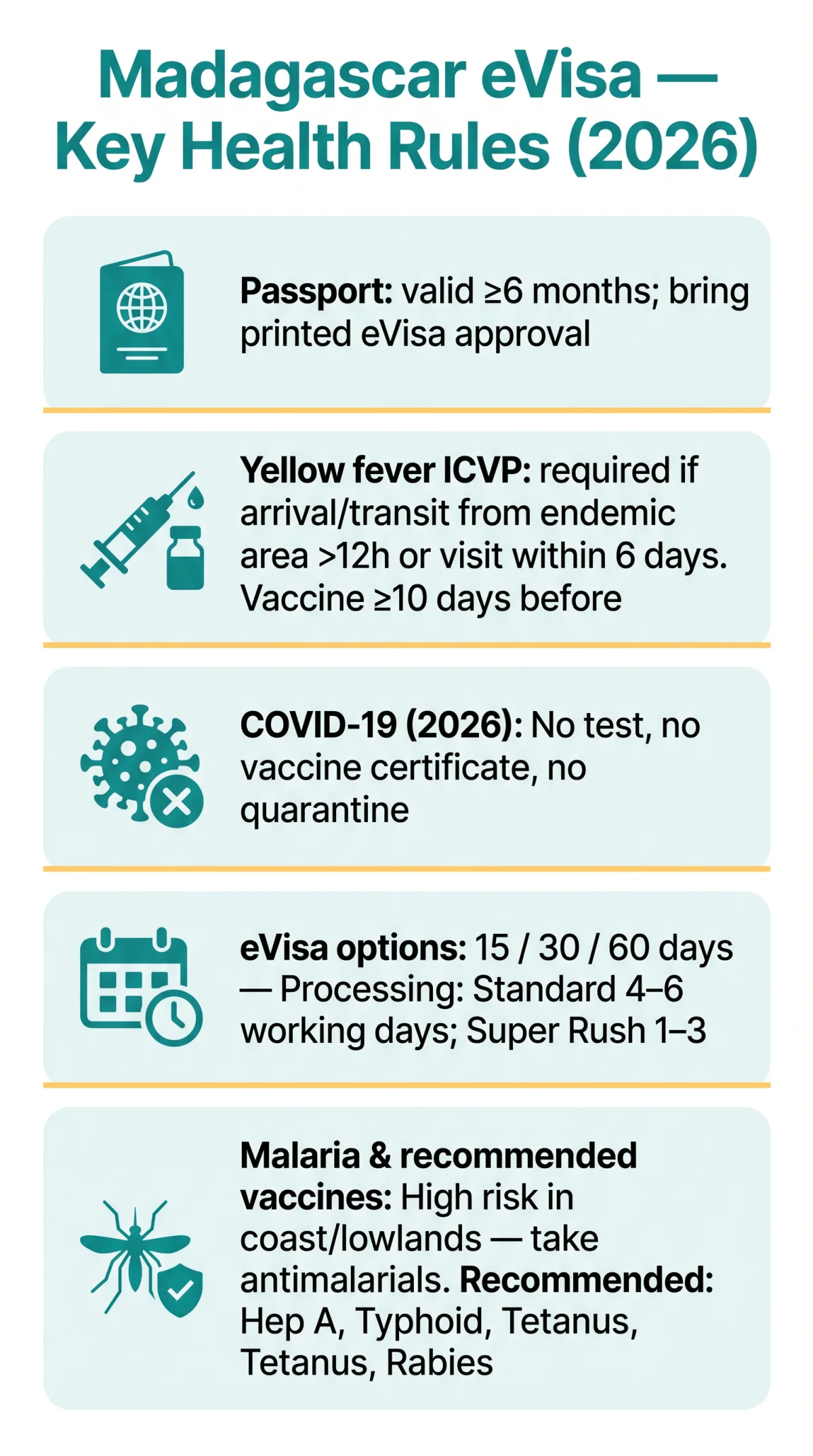
Madagascar eVisa health requirements for UK travellers in 2026 focus on yellow fever vaccination certificates if arriving from an endemic area. COVID-19 tests, vaccination certificates, and quarantine are not required. A valid passport (at least 6 months) and ICVP (if applicable) are checked at the border, not uploaded online.
What Are the Madagascar eVisa Health Requirements in 2026?
To meet Madagascar eVisa health requirements, UK applicants need a passport valid for at least 6 months from the planned arrival date. Three single-entry eVisa variants exist: 15-day, 30-day, and 60-day. Standard processing takes 4 to 6 Working Days; Super Rush takes 1 to 3 Working Days (extra fee). eVisa customer support is available 24/7 (response within 72 hours). Current Madagascar eVisa health requirements require a yellow fever certificate only if arriving from or transiting through endemic areas for over 12 hours.
Yellow Fever Vaccination Certificate – Rules for UK Travellers
Madagascar eVisa health requirements mandate that anyone arriving from or transiting through yellow fever-endemic countries for over 12 hours must present a valid International Certificate of Vaccination or Prophylaxis (ICVP) at the border. Failure to meet Madagascar eVisa health requirements may result in denial of entry.
| Travel Scenario | Yellow Fever Certificate Required? |
|---|---|
| Direct flight from the UK | No |
| Transit through endemic country (e.g., Kenya, Ethiopia) for over 12 hours | Yes |
| Previous visit to endemic area within 6 days of arrival | Yes |
Yellow Fever Certificate Validity and Timing Rules
Madagascar eVisa health requirements comply with WHO standards: the ICVP is valid for life under WHO International Travel and Health guidelines. The vaccine must be administered at least 10 days before arrival; vaccination fewer than 10 days before arrival will not be accepted. The physical ICVP document is checked at border control, not uploaded to the eVisa portal. UK travellers can obtain the vaccine through Passport Health (over 300 locations globally).
COVID-19 Health Requirements for Madagascar in 2026
As of September 2026, Madagascar eVisa health requirements no longer include COVID-19 restrictions. Current Madagascar eVisa health requirements are confirmed by the UK government’s foreign travel advice portal and TravelHealthPro:
| Requirement | Status (2026) |
|---|---|
| Pre-departure PCR or antigen test | Not required |
| COVID-19 vaccination certificate | Not required |
| Quarantine (formerly up to 21 days) | Not enforced |
| Health declaration form | Not required |
Compared to 2025, the health declaration form and 21-day quarantine have been permanently lifted. The yellow fever requirement remains unchanged; the 12-hour transit rule aligns with WHO recommendations. Last verified: September 2026.
eVisa vs. Health Requirements – What Is Checked Where?
Madagascar eVisa health requirements do not involve uploading health documents during the online application; a scanned passport bio page suffices. Yellow fever certificates are checked physically at the border on arrival. Madagascar eVisa health requirements separate the online application from border health inspections:
| What | Where Checked | When |
|---|---|---|
| Passport validity | eVisa portal (online) | During application |
| Yellow fever ICVP | Border control (physical) | On arrival |
| COVID-19 test/vaccination | Not required (2026) | N/A |
| Health declaration form | Not required (2026) | N/A |
| Travel insurance | Recommended (not mandatory) | N/A |
Recommended Vaccines and Malaria Prevention for Madagascar (2026)
Madagascar eVisa health requirements recommend that UK travellers consult a travel health professional at least 6 weeks before departure. Recommended (non-mandatory) vaccines include Hepatitis A, Typhoid, Tetanus, and Rabies. All travellers should ensure MMR or MMRV vaccination is up to date per the Measles Prevention Recommendation.
| Vaccine | UK Availability (Sep 2026) | Lead Time |
|---|---|---|
| Yellow Fever | Available – Passport Health, 300+ locations | At least 10 days before travel |
| Japanese Encephalitis | Out of stock (31 July 2026) | Check alternatives |
| Rabies | Available – private clinics | 3 doses over 21 to 28 days |

Madagascar eVisa health requirements also address malaria prevention. Malaria risk is high in coastal and lowland regions; highlands (including Antananarivo) are lower risk. The UK Health Security Agency’s Malaria Prevention Guidelines 2026 (updated 03 August 2026) advise antimalarial medication. Mefloquine (Lariam) 250mg shortage continues in the UK as of 09 September 2026; alternatives include Malarone or doxycycline. NaTHNaC advice line: 020 7383 7474 (Mon to Thu 09:00-11:00, Fri 09:00-10:30, from 7 September 2026). For consular assistance, the Embassy of Madagascar in London is at One Knightsbridge Green, 5th Floor, London, SW1X 7QA, United Kingdom (phone: +44 2070528277, Mon/Tue/Fri 10:00-12:00; email subject line: VISA_[Your Name]).
What Happens at the Airport – Arrival Health Checks
Madagascar eVisa health requirements apply at Ivato International Airport (TNR), where arriving passengers may undergo thermal temperature screening. Keep your passport, printed eVisa approval, and ICVP (if applicable) ready for border inspection to comply with Madagascar eVisa health requirements.
Health requirements can change without notice. Always confirm the latest Madagascar eVisa health requirements with the Embassy of Madagascar in London and your travel health clinic at least 6 weeks before departure. This article does not constitute medical advice.
Published: 10 September 2026 | Last reviewed: 10 September 2026. This content is reviewed quarterly or whenever official guidance changes. Next scheduled review: December 2026.
FAQ – Madagascar eVisa Health Requirements for UK Travellers
What health documents do UK citizens need for Madagascar eVisa in 2026?
Madagascar eVisa health requirements for 2026: passport valid for 6 months; yellow fever certificate if arriving from endemic area. No COVID-19 requirements.
Do I need a yellow fever certificate for Madagascar if flying directly from the UK?
Direct UK flight: no. Transit over 12 hours in endemic country or visit within 6 days: yes.
Is Madagascar high risk for malaria in 2026?
Madagascar eVisa health requirements flag malaria as high risk on coast/lowlands; highlands lower. Antimalarials advised. Mefloquine shortage in UK (09 Sep 2026) – use Malarone or doxycycline.
Do I need travel health insurance to enter Madagascar?
Not legally mandatory but strongly recommended – include medical evacuation coverage.
What happens if I don’t have a yellow fever certificate upon arrival?
Under Madagascar eVisa health requirements, no endemic visit means no certificate needed. Otherwise, no certificate means denial of entry at the border.
Can I swim in freshwater lakes in Madagascar’s national parks?
Avoid freshwater (rivers/lakes) in parks such as Isalo and Andasibe – schistosomiasis risk. Use chlorinated pools.
Is plague a risk in Madagascar?
Seasonal plague (Yersinia pestis) outbreaks in inland areas. Avoid crowded settlements; consult NaTHNaC before departure.
When is the best time to visit Madagascar for health and safety?
Dry season May to October (lower risk). Cyclone season November to April brings flooding and disease risks.