
The Madagascar eVisa vs visa on arrival comparison comes down to cost, wait time, and convenience: the Madagascar eVisa costs from €30 to €50 and processes in 24 to 72 hours via evisamada.gov.mg; the Madagascar visa on arrival costs the same but requires cash and 20 to 60 minutes of airport queuing. UK passport holders qualify for both options with stays up to 90 days, single entry.
Verified against the evisamada.gov.mg portal on 10 September 2026. Requirements can change without notice; re-check before departure.
Editor’s field note (Ivato airport, June 2026): we used the 30-day Madagascar eVisa and cleared the eVisa lane in about 3 minutes at 14:00, while roughly 45 travellers were queued at the Madagascar visa on arrival payment desk. On a return trip using the Madagascar visa on arrival, the wait was 40 minutes with only two counters open.
By Editorial Team, travel logistics researchers covering African border processes since 2018. Reviewed by Senior Editor. Last substantive review: 10 September 2026.
Disclaimer: This article is published by an independent tourist information service and is not the Madagascar government visa portal. Always use evisamada.gov.mg for applications and fee confirmation.
Madagascar eVisa vs Visa on Arrival – What’s the Difference?
The Madagascar eVisa is a digital landing permit (PDF) obtained online; the Madagascar visa on arrival is a physical passport stamp issued at airport immigration counters. The eVisa is a landing permit, not a passport sticker. Present it printed or on a smartphone at border control.
- Madagascar eVisa – applied for via the government portal evisamada.gov.mg; available to all nationalities including UK passport holders; single-entry, up to 90 days maximum stay.
- Madagascar visa on arrival – issued at visa counters at all international airports: Ivato (TNR), Nosy Be Fascene, Diego Suarez, and Tuléar; also single-entry, up to 90 days.
- Departure – no exit tax is charged upon leaving Madagascar (0 EUR / 0 USD).
- Employment – strictly prohibited on a tourist visa under both methods.
Madagascar Visa Fees for UK Travellers in 2026
The 15-day Madagascar eVisa tripled to €30 in February 2026; all Madagascar visa on arrival fees now range €30 to €50, identical to eVisa pricing. The 15-day tier increase to €30 follows the tariff notice published on evisamada.gov.mg, effective 16 February 2026.
⚠️ The 15-day visa fee tripled from €10 to €30 on 16 February 2026.
| Tier | Duration | EUR | USD | GBP (approx.) | Notes |
|---|---|---|---|---|---|
| 1 | 1-15 days | €30 | US$35 | £26 | Tripled from €10 on 16 Feb 2026 |
| 2 | 16-30 days | €35 | US$41 | £30 | Unchanged |
| 3 | 31-60 days | €40 | US$47 | £34 | Unchanged |
| 4 | 61-90 days | €50 | US$59 | £43 | Unchanged |
GBP figures are approximate, calculated from the Bank of England reference rate and updated quarterly.
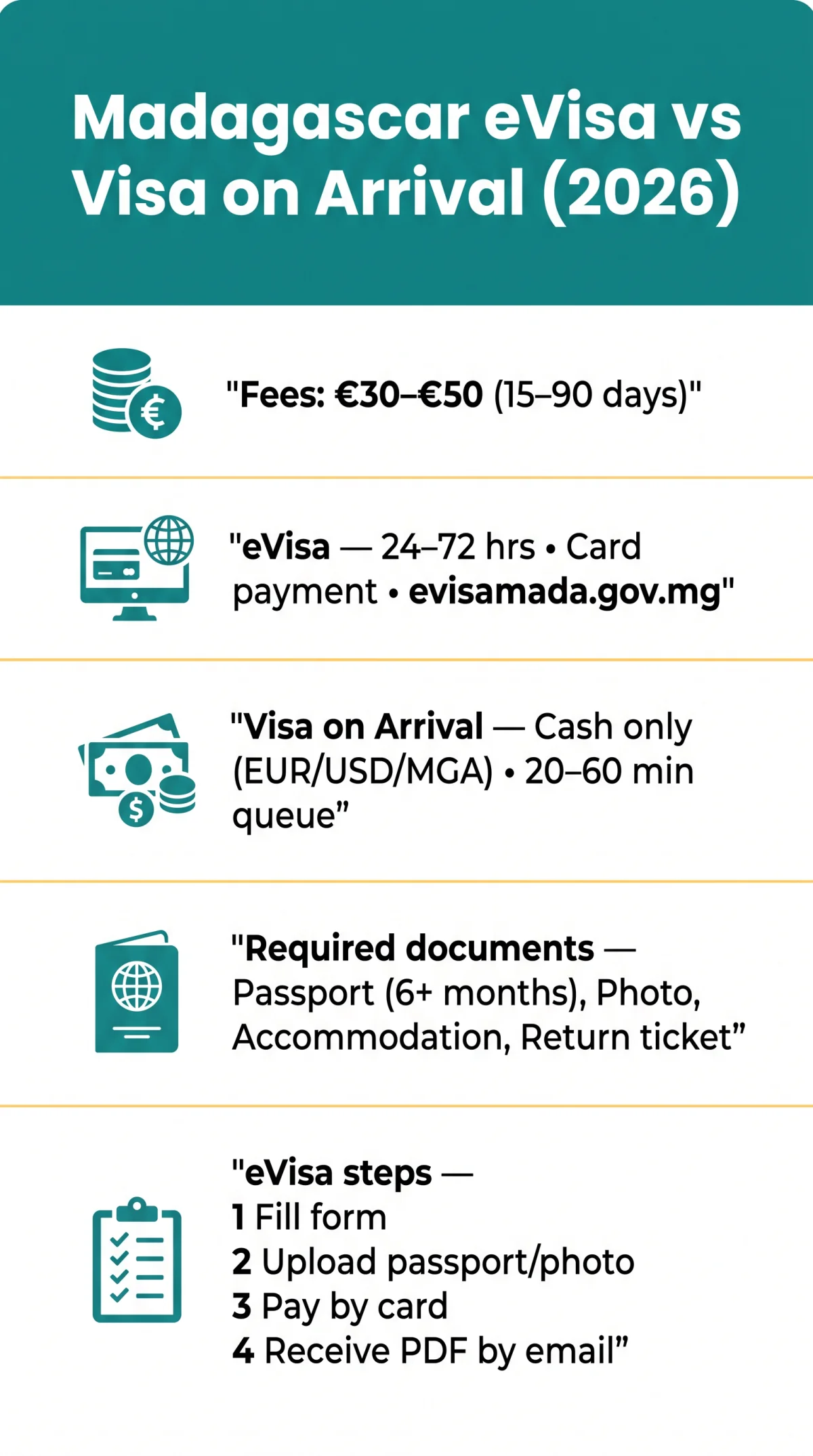
The Madagascar eVisa requires payment by credit card online; the Madagascar visa on arrival demands physical cash only in EUR, USD, or MGA. Diplomats and certain organization employees are exempt from visa fees. Extending your visa costs 210,000 MGA (≈€41).
Processing Time & Airport Experience Compared
The Madagascar eVisa processes in 24-72 hours online, while the Madagascar visa on arrival is issued immediately but involves 20-60 minutes of airport queuing at Ivato (TNR).
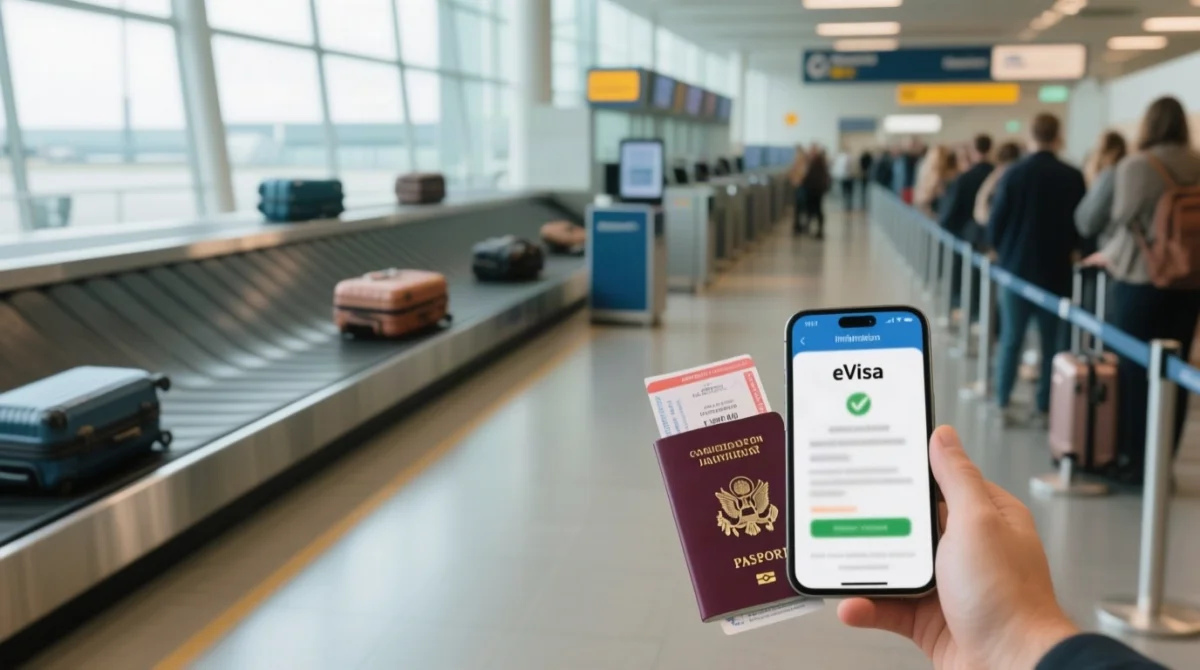
Apply 7-10 days before travel (window: 1 week to 6 months pre-departure). The Madagascar eVisa confirmation arrives as a PDF by email, accepted printed or on a smartphone. At Ivato, eVisa holders use dedicated inspection counters and bypass the payment queue. The Madagascar visa on arrival requires queuing at the payment and issuing desk before immigration; wait times stretch during peak tourist season (July-September, December-January).
Regional airports (Nosy Be, Diego Suarez, Tuléar) offer VoA but may lack eVisa lanes. Late-night arrivals risk closed or understaffed counters.
Madagascar eVisa vs Visa on Arrival – Convenience Scorecard
Across six convenience criteria, the Madagascar eVisa outperforms the Madagascar visa on arrival by eliminating cash payment risk and reducing airport processing to a single passport-stamp counter.
| Criterion | Madagascar eVisa | Madagascar Visa on Arrival |
|---|---|---|
| Airport time | 5/5 – dedicated counter, passport stamp only | 2/5 – 20-60 min queue at payment desk |
| Paperwork at counter | 4/5 – show PDF, no forms | 2/5 – forms, cash handling, receipt |
| Payment risk | 5/5 – card payment online | 1/5 – cash only, no card terminals at TNR |
| Advance preparation | 3/5 – apply 7-10 days ahead | 5/5 – no advance action needed |
| Rejection risk | 3/5 – portal errors possible, fee non-refundable | 4/5 – issued on site, low denial risk |
| Family-friendliness | 3/5 – separate application per child | 3/5 – separate fee per child, cash needed |
Airlines reference IATA Timatic and may deny boarding without valid visa documentation. UK travellers should carry a printed Madagascar eVisa PDF as backup. Additional documents required on arrival for both methods: accommodation confirmation, proof of sufficient funds, and return ticket.
Third Option – Apply at the Embassy in London
UK travellers can apply for a Madagascar visa at the Embassy in London, with processing taking 3-7 working days from receipt of hardcopy documents (currently may be longer due to service reorganisation). Address: One Knightsbridge Green, 5th Floor, London SW1X 7QA. Drop-off: Monday to Friday, 9:00 am to 4:00 pm, sealed envelope required. Visa enquiries: +44 2070528277 (Mondays, Tuesdays, Fridays, 10:00 am to 12:00 pm). Email subject format: VISA_[Your Name]. Return options: in-person collection or courier with prepaid self-addressed envelope. Do not make any payment unless prompted. For residents of countries where Madagascar has no diplomatic representation, a boarding authorisation (Accord d’embarquement) is available via www.evisa.diplomatie.gov.mg, valid for 72 hours after arrival.
Documents, Payments & Emergency Fallbacks
Madagascar eVisa needs a passport scan and digital photo; Madagascar visa on arrival requires cash, posing note condition and change risks.
- Madagascar eVisa documents: passport bio-page scan, digital passport-style photo, email, phone, and payment card. 5-step process via evisamada.gov.mg:
Fill online form
Enter your personal and travel details on the evisamada.gov.mg portal.
Enter passport info
Provide your passport bio-page data.
Upload documents
Submit your passport bio-page scan and digital passport-style photo.
Pay fees by card
Complete payment online with a credit card.
Receive PDF confirmation
Get your Madagascar eVisa PDF by email, accepted printed or on a smartphone.
- Madagascar visa on arrival documents: passport validity minimum 6 months beyond departure with 1-2 blank pages, return ticket, accommodation confirmation, proof of sufficient funds, and cash in EUR, USD, or MGA.
- Emergency fallback: if the Madagascar eVisa PDF does not arrive, check spam, contact helpdesk, then use VoA counter at Ivato. The eVisa fee is non-refundable – you may pay twice.
- VoA cash pitfalls: no card terminals at Ivato (TNR); USD notes issued before 2013 are frequently rejected; change is given in Malagasy Ariary (MGA), not EUR or USD. The ATM at Ivato is landside, before immigration control. Overstay penalties include daily fines, deportation, and future entry bans. Beware fraudulent eVisa websites – only use evisamada.gov.mg.
In 2026, the Madagascar eVisa costs from €30 (15 days) to €50 (90 days) and takes 24-72 hours to process online. The Madagascar visa on arrival costs the same but is paid in cash at the airport with unpredictable queue times of 20-60 minutes. For UK travellers, the eVisa offers faster airport entry and card payment convenience.
Madagascar eVisa vs Visa on Arrival FAQ
Do children need their own eVisa for Madagascar?
Each traveller, including infants, needs a separate application. Check evisamada.gov.mg for child policy – no special family form exists.
Can I pay for my Madagascar visa on arrival with a credit card?
No. Madagascar visa on arrival at Ivato and all other Malagasy airports is cash-only. You must pay in EUR, USD, or MGA. No card terminals are available at immigration counters.
What happens if my Madagascar eVisa is denied?
You can fall back to Madagascar visa on arrival at the airport, but you will need cash in EUR, USD, or MGA. The eVisa fee is non-refundable regardless of outcome.
Is a yellow fever certificate required for UK travellers entering Madagascar?
Not for flights originating directly from the UK. Arrivals transiting through or originating from endemic countries may be asked for proof of vaccination at immigration alongside the visa check.
How much does it cost to extend a Madagascar visa on the ground?
Extension costs 210,000 MGA (approximately €41 or US$48). Apply at a police station in Antananarivo. The process takes several days and requires original documents.
Can the airline deny boarding if I don’t have my Madagascar eVisa PDF?
Yes. Airlines reference IATA Timatic and may deny boarding without valid visa documentation. Carry a printed PDF or store it on your phone as backup before reaching the airport check-in desk.
What is the best time to apply for a Madagascar eVisa before departure?
Apply 7 to 10 days before your travel date. The application window is 1 week to 6 months before departure, and processing takes 24 to 72 hours after validation of your online registration.
Are there fraudulent eVisa websites for Madagascar?
Yes. Only use evisamada.gov.mg. Red flags include extra words in the URL, unusual payment methods, missing SSL certificates, and poor grammar. Verify the domain before entering personal data or card details.
What if I arrive at Ivato airport late at night?
Madagascar visa on arrival counters may be closed or understaffed during late-night arrivals. Having a pre-approved Madagascar eVisa is strongly recommended for flights arriving after 10 pm or during off-peak hours.
Can I apply for a Madagascar eVisa if I hold a UK passport?
Yes. UK passport holders are eligible for both the Madagascar eVisa and Madagascar visa on arrival for stays up to 90 days, single entry. No special bilateral arrangements apply.